
Why Low-Slope Roofing Dominates Commercial Buildings Here
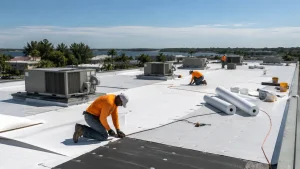
Most commercial buildings along Coleman Boulevard and the Shem Creek corridor in Mount Pleasant carry low-slope roofs, a design choice driven by cost per square foot, usable rooftop space, and easy access to HVAC equipment. That flat profile faces a coastal climate that punishes weak workmanship fast.
Salt air, driving rain, and summer heat all work against a poorly built system. This guide covers membrane options, the installation sequence, wind and code requirements, drainage details, and how to vet a contractor for commercial flat roof installation in Mount Pleasant, SC.
Understanding Commercial Low-Slope Roof Systems
A flat roof is never truly flat. Building codes require a minimum slope, usually a quarter inch per foot, so water moves toward drains instead of pooling. On paper the roof reads as level, but the assembly underneath is engineered to shed water across a large horizontal area.
The system has layers that each do a job. From the top down you typically find the waterproof membrane, a cover board, rigid insulation, a vapor consideration, and the structural deck. When any single layer is compromised, the whole assembly loses performance.
Commercial roofs also carry loads that residential roofs never see. Rooftop units, condensers, exhaust fans, and service foot traffic all concentrate stress at specific points. A good design accounts for that traffic with walk pads and reinforced details.
How a Commercial Roof Differs From a Residential One
The differences go beyond size. Residential steep-slope roofs rely on gravity and overlapping shingles. A commercial low-slope roof relies on a continuous waterproof surface, so every seam and penetration becomes a potential failure point.
- Membrane continuity matters more than shingle overlap.
- Drainage design is engineered, not assumed.
- Rooftop equipment creates dozens of penetrations to flash.
- Fire and wind ratings follow commercial code, not residential.
One of the most common mistakes we see is a residential crew treating a commercial deck like a big house. It looks fine for a season, then the first hard nor’easter drives water under a poorly terminated edge and the ceiling tiles inside start staining.
Membrane Materials That Perform in the Lowcountry
Material choice drives how long your roof survives Charleston-area weather. The four systems we install most on commercial buildings each have a place, and the right pick depends on the building’s use, rooftop equipment, and budget priorities over the roof’s lifespan.
TPO and PVC are heat-welded single-ply membranes with reflective white surfaces that reduce cooling loads through our long summers. EPDM is a durable rubber membrane known for flexibility and long track records. Modified bitumen and built-up roofing offer multiple redundant layers that appeal to owners who want extra puncture resistance.
| System | Key Strength | Best Fit | Coastal Note |
|---|---|---|---|
| TPO | Reflective, welded seams | Retail, office, warehouse | Strong UV resistance |
| PVC | Chemical and grease resistant | Restaurants, kitchens | Excellent salt-air durability |
| EPDM | Flexible, long history | Large open roofs | Dark surface absorbs heat |
| Modified Bitumen | Multi-ply redundancy | High-traffic roofs | Handles ponding well |
Choosing Between Single-Ply and Multi-Ply
Single-ply membranes install faster and weigh less, which matters on older buildings with load limits. Multi-ply systems add redundancy but take longer and cost more in labor. For restaurants near Shem Creek, we often steer owners toward PVC because it resists the grease and animal fats that vent onto the roof and degrade other membranes.
The technical detail that separates good from bad work here is the weld. Hot-air welded seams on TPO and PVC need the right temperature and speed. Rushing that step leaves a cold weld that looks bonded but peels apart within a year, and that is exactly where leaks begin.
The Flat Roof Installation Process, Step by Step
A professional Roof Installation follows a sequence that protects both the building and the warranty. Skipping steps to save days almost always shows up later as premature failure. Here is how a well-run commercial project moves from start to finish.
Inspection and Moisture Survey
Before we quote a system, we take core samples and check the existing deck and insulation for trapped moisture. On buildings across Mount Pleasant and Daniel Island, we frequently find saturated insulation hidden under a membrane that still looks intact from above.
This survey decides whether the job is a recover or a full tear-off. Building a new roof over wet insulation traps that moisture, rots the deck, and voids most manufacturer warranties.
Tear-Off, Deck Prep, and Insulation
When a tear-off is required, the crew strips the old assembly down to a clean, dry deck. Any rotted decking gets replaced. Then rigid insulation boards go down, tapered where needed to improve drainage toward drains and scuppers.
- Deck repair before anything else covers it.
- Vapor and insulation layers sized to code and R-value targets.
- Cover board to protect the membrane from foot traffic.
- Fastening pattern engineered for local wind uplift.
Membrane Application and Detailing
The membrane is mechanically fastened, fully adhered, or ballasted depending on the design. Seams are welded or seamed, and every penetration gets a custom flashing detail. The final walk-through checks each weld with a probe.
Homeowners and property managers often ask whether the roof can be installed while the business stays open. The honest answer is yes for most single-story buildings, since we stage the work in sections and protect interior spaces, though noise and rooftop access will be limited during active phases.
How Charleston’s Coastal Climate Shapes Roof Decisions
Roofing on the coast is a different animal than roofing inland. In the Mount Pleasant area, salt-laden air, intense UV, high humidity, and hurricane-season wind all attack a roof at once. A system that thrives in the Midwest may corrode or degrade here far faster.
Salt air accelerates corrosion on fasteners, metal edges, and flashings. That is why we specify coated or stainless hardware and marine-grade metal details on buildings near the water in Isle of Palms and along the harbor.
Humidity affects installation itself. Adhesives, primers, and coatings need dry surfaces and specific temperature ranges to cure. In our climate, morning dew and afternoon thunderstorms shrink the daily work window, so scheduling around the forecast is part of doing the job right.
Wind Uplift and Storm Resilience
Hurricane and tropical storm exposure means wind uplift resistance is central to any coastal design. The edge metal, the fastening pattern, and the membrane attachment method all have to be rated for the loads a low-slope roof faces during a named storm.
In coastal South Carolina, the perimeter and corners of a flat roof see the highest uplift pressures, which means those zones need denser fastening than the field. A crew that fastens the whole roof on one uniform pattern is leaving the most vulnerable areas underbuilt, and that is where peel-back failures start in high wind.
Permits, Codes, and Wind Requirements for Commercial Roofs
Commercial roofing in the Town of Mount Pleasant and greater Charleston County follows the adopted building code, which sets standards for wind resistance, fire rating, energy performance, and inspection. Pulling the correct permit is not optional, and skipping it creates problems at resale or insurance renewal.
Coastal jurisdictions enforce specific wind-load requirements tied to the region’s design wind speeds. Your roof assembly, from deck attachment to edge metal, must be documented to meet those numbers. Manufacturer approvals and tested assemblies are how we prove compliance.
- Permit and inspection through the local building department.
- Wind-rated assemblies matched to coastal design speeds.
- Energy code compliance for insulation R-values.
- Fire classification appropriate to the building type.
Why Documentation Protects the Owner
A code-compliant Roof Installation comes with paperwork: product data, warranty registration, and inspection sign-offs. On premium properties in Kiawah Island and Seabrook Island, insurers increasingly ask for this documentation before writing or renewing coverage.
In coastal South Carolina, an undocumented roof can quietly raise your premiums or complicate a claim after a storm. The honest answer property managers deserve is that the permit and the paper trail are not bureaucracy, they are what stands between you and a denied claim when it matters most.
Drainage, Insulation, and Details That Prevent Leaks
The membrane gets the attention, but leaks almost never start in the open field of the roof. They start at drains, penetrations, and transitions. Getting these details right is the difference between a roof that lasts decades and one that calls for service every rainy season.
Slope and Drainage Design
Water is the enemy of any low-slope roof. Proper tapered insulation and correctly placed drains keep water moving instead of ponding. Standing water magnifies UV damage, freezes and expands on rare cold nights, and adds dead load the structure was not designed to carry.
One of the most common mistakes we correct is a roof with drains set too high or too few for the surface area. It looks acceptable when dry, then after a heavy Lowcountry downpour the roof holds water for days and the seams slowly break down.
Flashing, Penetrations, and Edge Metal
Every pipe, curb, drain, and parapet wall needs a purpose-built flashing detail. HVAC curbs on commercial buildings are a frequent leak source because they are numerous and often reworked by other trades who cut the membrane.
- Pipe boots welded or sealed to the membrane.
- HVAC curb flashing tied cleanly into the field.
- Parapet and wall terminations with counterflashing.
- Perimeter edge metal rated for coastal wind.
The technical step that separates lasting work here is the termination at walls and edges. It needs a secure mechanical fastener and a fully sealed edge. Rushing that termination leaves a lip the wind can catch, and once wind gets under the edge, the failure spreads across the roof.
Maintenance and Knowing When to Replace or Restore
A commercial flat roof is an asset that rewards attention. Twice-yearly inspections, especially after storm season, catch small problems while they are still cheap to fix. Clearing drains, checking seams, and resealing penetrations extend the life of the whole system.
When a roof reaches the end of its service life, owners face a choice between restoration and full replacement. A restoration coating can add years to a membrane that is sound but weathered. It is not a fix for a roof with wet insulation or failing seams.
Signs It Is Time for a New Roof
Certain warning signs point toward replacement rather than another patch. Recurring interior leaks, widespread membrane cracking, and saturated insulation all signal that the assembly has passed the point of economical repair.
- Leaks in multiple locations after every rain.
- Blistering or splitting across the membrane.
- Wet or compressed insulation found in core samples.
- Rusted or loose edge metal from salt exposure.
The honest answer many owners need to hear is that chasing leaks year after year usually costs more than a planned Roof Installation. Once a system is losing multiple details at once, a full replacement resets the clock and restores warranty protection that patchwork can never match.
Building a Maintenance Plan
A simple maintenance agreement keeps your roof under warranty and your records current. We document each visit, flag developing issues, and prioritize repairs so a small budget goes to the details that protect the building most, which keeps surprise failures off your roof and off your books.
FAQ: Commercial Flat Roofing Questions Answered
How long does a commercial flat roof last in Mount Pleasant, SC?
A properly installed single-ply membrane roof in the Lowcountry typically lasts between 20 and 30 years, depending on the material and maintenance. PVC and TPO tend to hold up well against coastal UV and salt exposure. EPDM performs strongly too. The biggest variable is installation quality, since poor seams and flashing fail long before the membrane itself wears out.
Can a flat roof be installed over an existing one?
Sometimes. Code allows a limited number of roof layers, and a recover can save on tear-off, but only if the existing deck is dry and structurally sound. If moisture is trapped in the insulation or the deck shows rot, a full tear-off is the honest recommendation. We take core samples before advising a recover on any Mount Pleasant building.
What causes most commercial flat roof leaks?
Most leaks start at penetrations and transitions, not the open field of the membrane. Poorly flashed HVAC curbs, drains, pipe boots, and parapet walls are the usual culprits. Standing water that never drains also breaks down seams over time. A good installation gives every penetration a properly welded or sealed detail, which is where experienced crews earn their reputation.
How long does a commercial flat roof installation take?
Most single-story commercial projects in Mount Pleasant take one to three weeks, depending on square footage, tear-off scope, and weather. Coastal rain and high humidity can extend timelines because adhesives and coatings need dry conditions to cure. We schedule around the forecast and stage the work so your business stays open during installation whenever possible.
Key Takeaways for Your Commercial Roof Project
A commercial flat roof is a system, not a single product. The membrane matters, but the drainage design, insulation, flashing, and edge details decide whether it survives coastal weather or fails early. Material choice should match how your building is used, from reflective TPO on warehouses to grease-resistant PVC on restaurants.
Charleston’s salt air, humidity, and storm-season wind raise the bar on both design and workmanship. Documented, code-compliant installation protects your insurance coverage and your investment. And the smartest owners plan replacement before the leaks pile up, rather than after.
Whether your building sits in Mount Pleasant, Daniel Island, or out toward Isle of Palms, the fundamentals hold: right system, right details, right crew. Get those three aligned and your roof becomes something you rarely have to think about.
Schedule Your Commercial Roof Assessment Today
Every rainy season a marginal roof survives, it loses a little more of its remaining life, and one named storm can turn a small edge weakness into an interior full of water damage. Acting before hurricane season, rather than during it, keeps you in control of the timeline and the budget.
Call us today at (843) 883-4130 and we will come to your building, take core samples, inspect the deck and every penetration, and give you a written plan that tells you exactly what your roof needs and why.
The visit is free and there is no obligation, and it usually takes under an hour on a single-story building. You can also schedule a free estimate online, and you are welcome to see our reviews on Google before you decide.
Find Trusted Roof Installation Near You in South Carolina
Fortrex Charleston LLC works on commercial and residential low-slope roofs across the Charleston coast, and we know how each community’s exposure to salt air and storm wind shapes the right system. From the harbor to the barrier islands, local knowledge is part of every project we take on.
Find your area below to learn more about our roofing services close to home.